
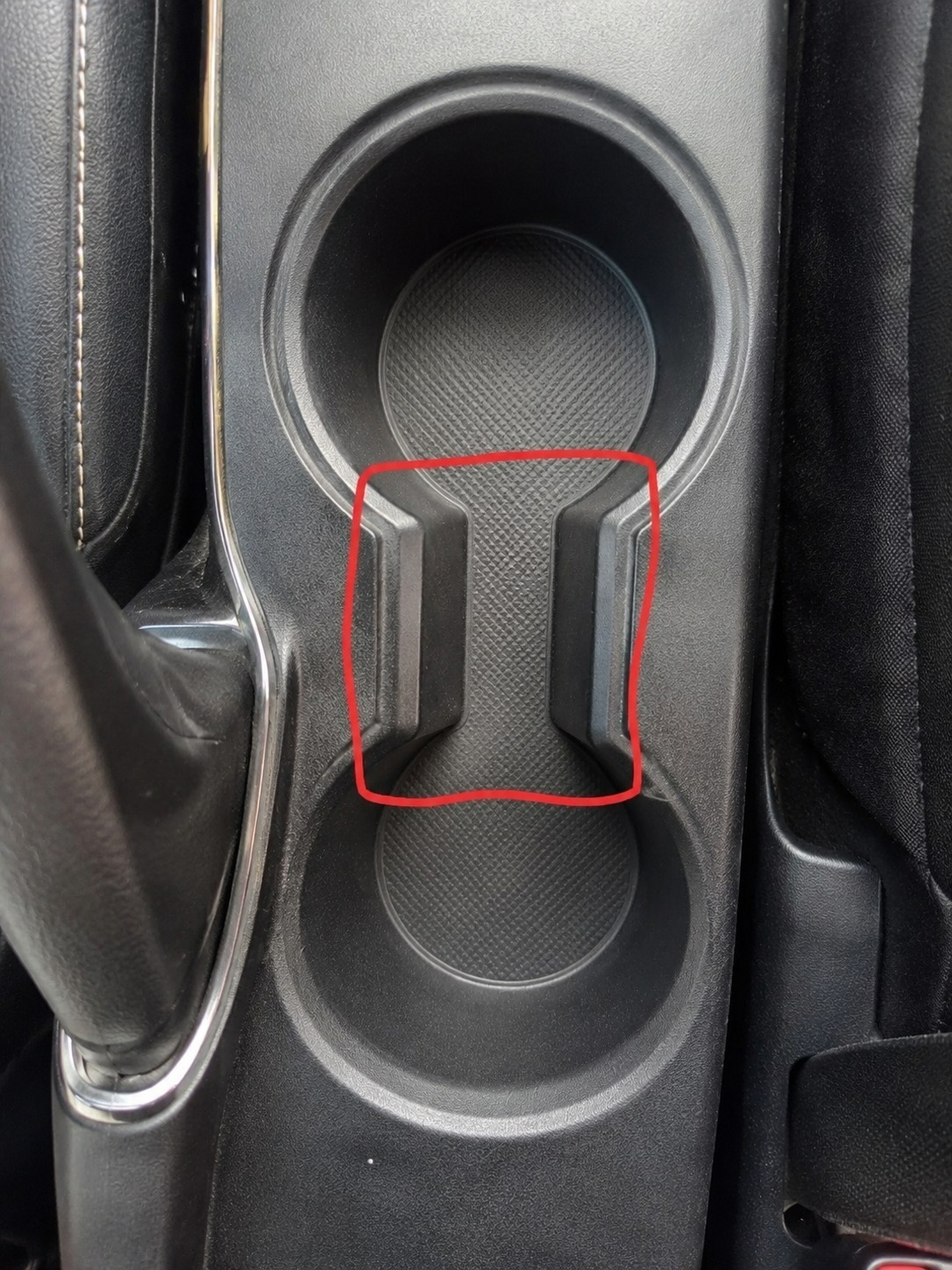
Let me walk you through the design.
The problem: Grocery bags in cars are a disaster. They tip over. Items roll out. Produce gets bruised. Jars break. And you spend the drive reaching into the back seat, trying to stabilize a bag that has no business being in a moving vehicle.
The solution: Create a dedicated slot for bag handles. But where? The cup holder is already there. It’s the perfect location—centered, accessible, and within reach of the driver.
The design: Two cup holders side by side, with a narrow slot between them. The slot is open at the top and bottom. The sides of the slot are slightly curved or tapered.
How to use it: Take your grocery bag (paper or plastic). Thread the handles through the slot from front to back. Let the bag hang down between the cup holders. The handles rest on the divider, supporting the weight of the bag. The bag hangs freely, not touching the floor.
The result: Your groceries stay upright. Nothing rolls away. You can reach down and grab items without taking your eyes off the road.
A Brief History of the Grocery Bag Holder
This feature didn’t appear overnight. It evolved.
Pre-cup holder era (before 1980s): Cars had ashtrays and cigarette lighters, not cup holders. Grocery bags went on the floor or the passenger seat. Chaos ensued.
Early cup holders (1980s-1990s): Cup holders were simple, shallow indentations in the dashboard or center console. No slots. No bag hooks. Groceries still problematic.
The innovation (late 1990s-early 2000s): Designers realized that the space between two cup holders could serve a dual purpose. The “gap” was born. Some manufacturers added dedicated bag hooks to the back of seats or the trunk, but the cup holder slot was an elegant, space-saving solution.
Modern era (2010s-present): Most cars still have the slot, though many drivers don’t know what it’s for. Some manufacturers have replaced it with deeper, more complex cup holder designs (adjustable inserts, removable dividers) that serve multiple functions. But the classic “gap” remains a common feature in many vehicles.
What Else Can You Use the Gap For?
The grocery bag is the primary intended use, but the slot is versatile.
Purse or handbag strap: Hook your purse strap through the slot. Your bag stays upright and accessible. No more reaching into the passenger footwell.
Reusable shopping bag handles: Same principle as disposable bags. Works perfectly.
Cell phone (landscape orientation): In some cars, the gap is wide enough to hold a phone horizontally. Not the intended use, but it works.
Pack of gum or mints: The classic “I don’t know what this is for, so I’ll just shove something in there” use.
Fast food bag handles: If you’re picking up takeout, loop the bag handles through the slot. Your fries won’t end up on the floor.
Keys or sunglasses (not recommended): Small items can fall through the slot. Use with caution.
Which Cars Have This Feature?
The grocery bag slot is most common in:
Honda and Acura vehicles (especially early 2000s models)
Toyota and Lexus models
Nissan and Infiniti
Ford and GM trucks and SUVs (often with larger, more versatile cup holder designs)
Mazda and Subaru
How to check: Look at your cup holders. Is there a narrow, open slot between them? Does the slot extend all the way through (open at the bottom)? If yes, you have a grocery bag holder.
Not all cars have it. Some newer vehicles have cup holders with removable inserts, sliding dividers, or deep wells that don’t accommodate a bag handle slot.
Why Don’t More People Know About This?
Let me be honest. This is a marketing failure.
Car manufacturers have a feature that saves groceries, reduces spills, and makes life easier. And they don’t tell anyone about it.
Possible reasons:
