
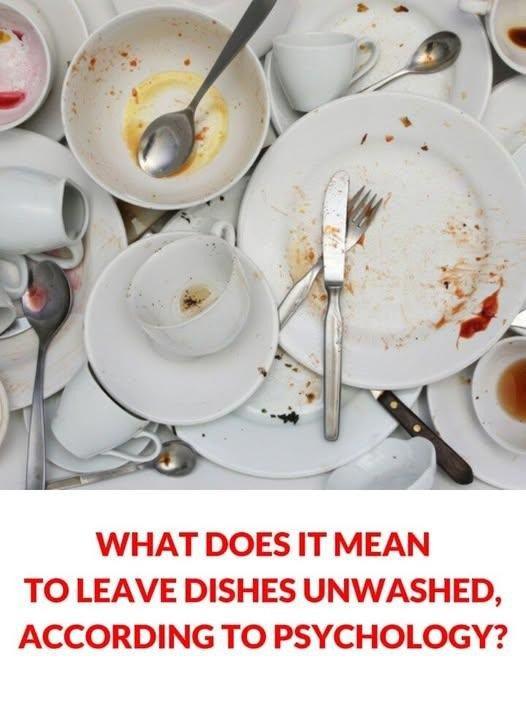
The Psychology Behind Dirty Dishes: What Your Kitchen Might Be Saying About You
We have all been there: a long day, a sink full of dishes, and a quiet internal negotiation about whether to deal with them now or later. Some people cannot go to bed with a single cup unwashed. Others let dishes pile up for days without a second thought. Neither response is random — and neither is necessarily a character flaw. Both are rooted in psychology that is worth understanding.
---
The Dish Pile as a Mirror
Your kitchen is one of the most-used spaces in your home, which makes it one of the most psychologically revealing. Unlike a guest bedroom that rarely gets touched, the kitchen accumulates evidence of your daily habits, energy levels, priorities, and emotional bandwidth in real time.
Psychologists who study the relationship between environment and mental health often describe the home as an extension of the self. When our inner world is chaotic, overwhelmed, or depleted, it frequently shows up in our outer environment — and the kitchen is often the first place it appears.
---
Why Some People Leave Dishes: The Real Reasons
🧠 Decision Fatigue and Mental Exhaustion
Very CommonBy the end of a demanding day, your brain has made thousands of decisions — from what to wear to how to respond to a difficult email. Psychologists call this decision fatigue: the deterioration of decision-making quality after a long session of choices. When you are mentally drained, even a simple task like washing dishes can feel disproportionately difficult. This is not laziness. It is your brain conserving its limited reserves of willpower and executive function.
😔 Depression and Low Motivation
Important SignalOne of the most consistent signs of depression is a loss of motivation for everyday tasks — particularly tasks that feel mundane or that offer no immediate reward. Dirty dishes are often one of the first things to pile up when someone is struggling emotionally. If you notice that household tasks you used to manage easily have become overwhelming or feel pointless, this deserves attention beyond cleaning tips. It may be worth talking to someone.
⏰ Procrastination and Task Avoidance
Very CommonProcrastination is not fundamentally about laziness — research consistently links it to emotion regulation. People procrastinate on tasks they find aversive, boring, frustrating, or anxiety-inducing. For some, the sheer monotony of washing dishes triggers avoidance. For others, a large pile has become so associated with guilt or overwhelm that approaching it feels worse than ignoring it. The pile grows not because of indifference, but because of discomfort.
🌊 Overwhelm and Life Transitions
SituationalMajor life events — a new baby, a job loss, a breakup, grief, illness, moving — can temporarily derail even the most organized person's domestic routines. During periods of overwhelm, the brain naturally triage tasks: what is truly urgent versus what can wait. Dishes often end up in the "can wait" category, which is a perfectly reasonable response to extraordinary circumstances. A messy kitchen during a hard season of life is not a character failure — it is a sign that your energy is going where it needs to go.
🔄 Personality Type and Cognitive Style
Trait-BasedResearch on the Big Five personality model consistently shows that people who score higher in conscientiousness — a trait associated with orderliness, discipline, and attention to detail — tend to maintain cleaner living spaces. People who score lower in conscientiousness are not morally inferior; they simply prioritize differently and have different thresholds for visual disorder. Similarly, people with a more "big picture" cognitive style may genuinely not notice — or not be bothered by — a pile of dishes that would immediately distress someone with a detail-focused mind.
---
What the Research Says
